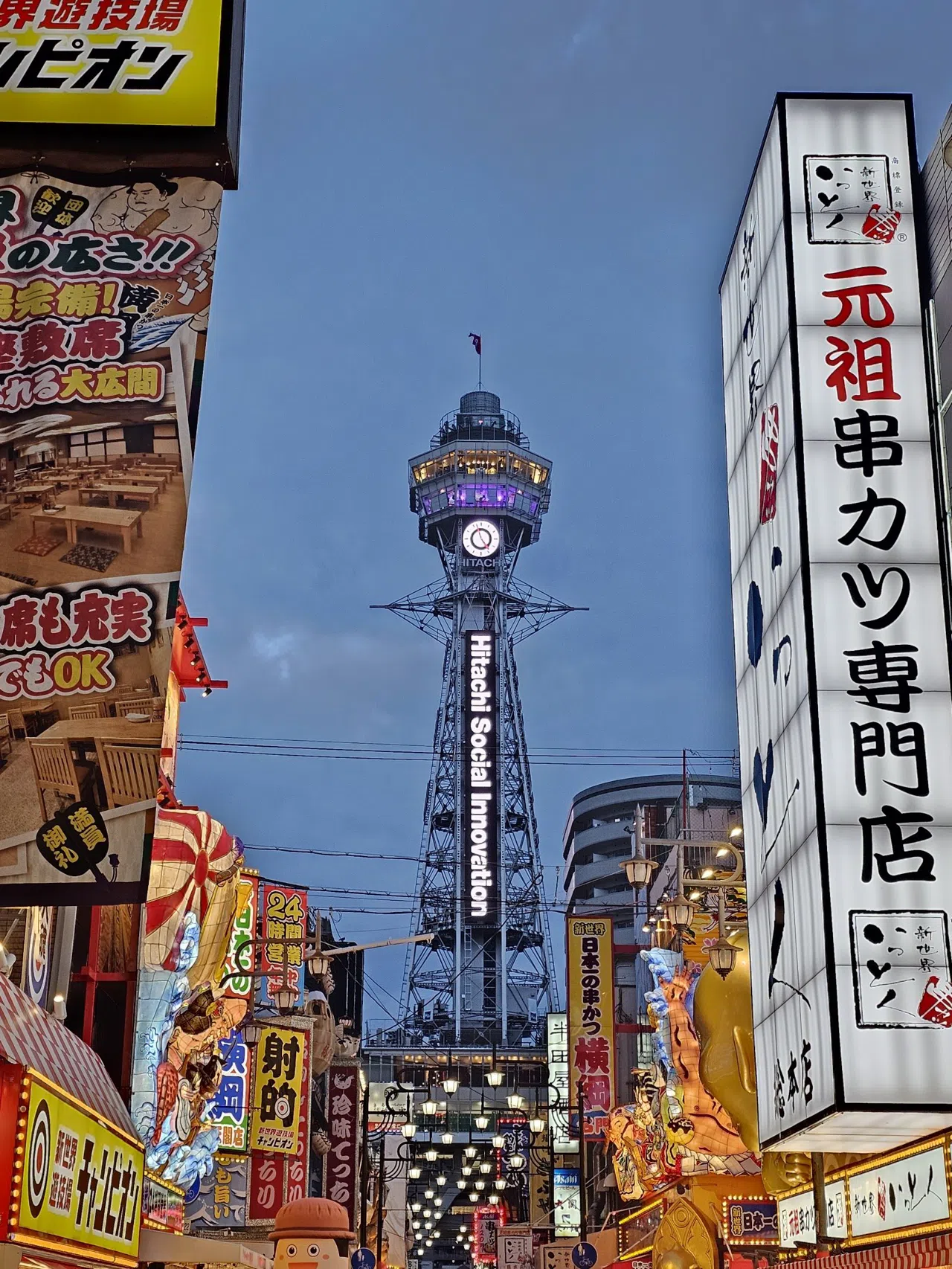
Stand at the base of Tsutenkaku on a weekday evening and you'll hear it before you see it — a recorded jingle looping over the intersection, the hiss of oil from a dozen kushikatsu counters, a paper lantern knocking against a doorframe with three stools behind it. This is Shinsekai, Osaka's oldest working-class quarter, and the tower rising above the lanterns and neon has been the district's private measure of luck for more than a century. It's a scuffed, generous, unglamorous corner of the city, and it rewards a visitor who slows down enough to notice the gap between the postcard and the pavement.
The Tower Itself
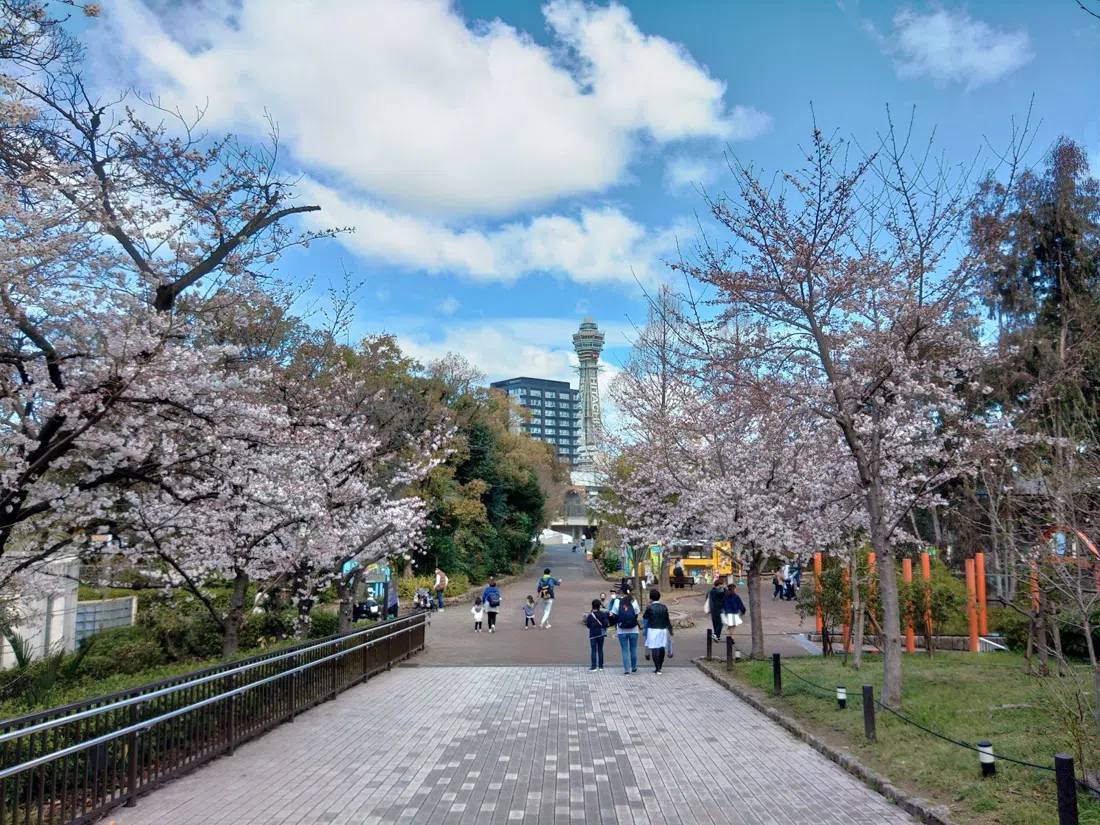
Tsutenkaku Tower (Shinsekai) is the literal spine of the story, and it's worth understanding before anything else in the district makes sense. The original 1912 tower was modelled loosely on Paris's Eiffel Tower with a nod to New York's Beaux-Arts height, built as Osaka's declaration that a merchant city could out-glitter the capital. It burned in a 1943 fire during wartime metal requisitioning and sat as a stump for over a decade — a fact locals still bring up, because the rebuilding in 1956 is the real origin of the tower's meaning here. It wasn't restored by the state; it was rebuilt because the neighbourhood wanted its landmark back. That's the working-class hope in the title: not aspiration handed down, but a symbol the district paid to resurrect itself.
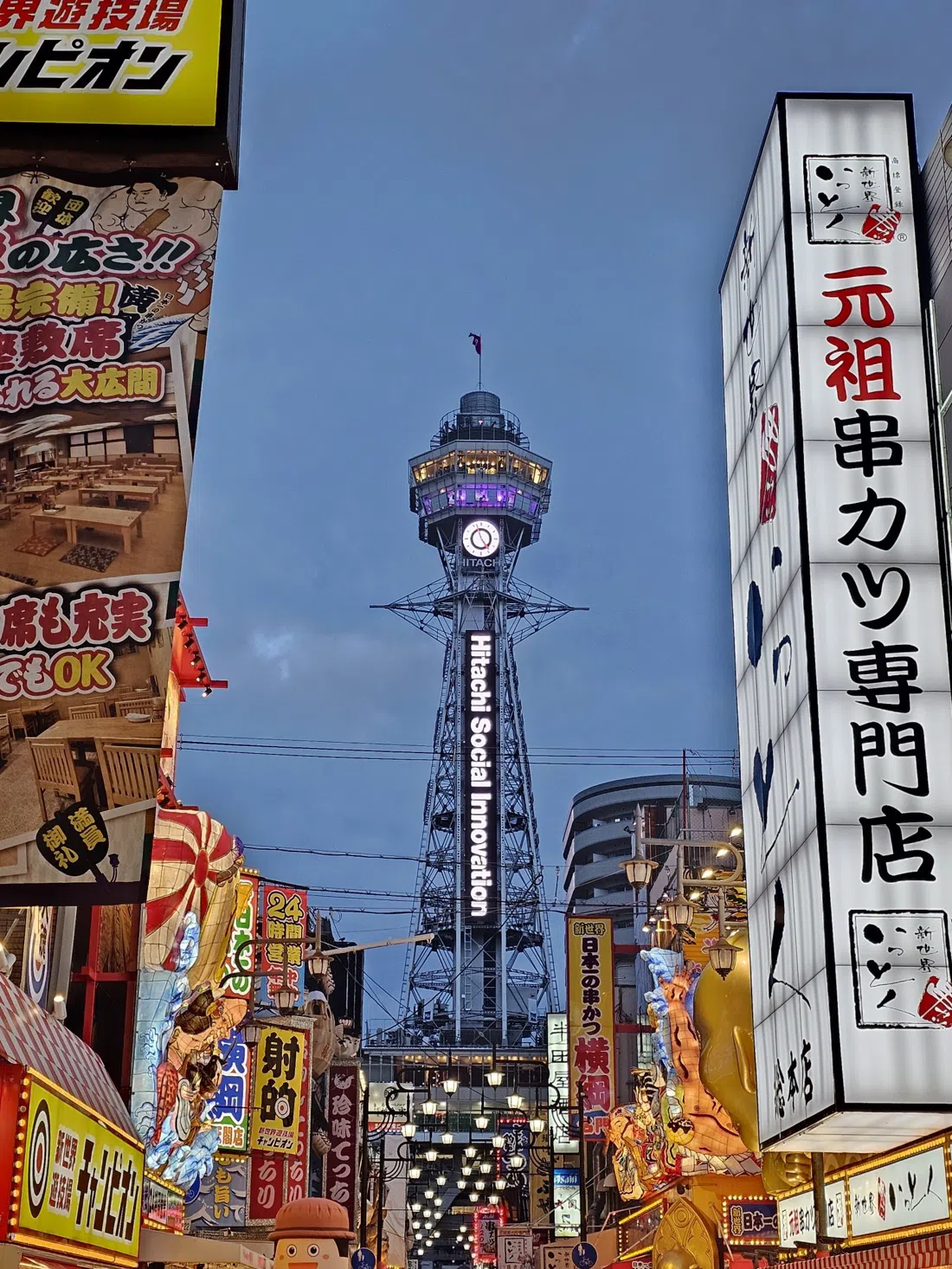
Practically, it's an easy visit. The main observation deck is ¥955, open daily 9:00–22:00 as of March 2026, and there's no reservation system — you queue for the elevator like everyone else, which at peak afternoon hours on a weekend can mean a genuine wait, but groups are welcome and there's no size cap to plan around. If you want the full theatrics, the All-in-One ticket (up to roughly ¥3,000) adds the Tower Slider and the Dive & Walk glass-floor experience, both of which are more fun with kids or a group willing to look mildly ridiculous together. Billiken, the tower's grinning good-luck mascot, sits on the observation floor and visitors rub his feet for luck before heading back down — a small ritual that sums up the neighbourhood's whole relationship with fortune: modest, a little kitsch, sincerely meant.
Eating in Shinsekai: The Kushikatsu Myth and the Kushikatsu Reality
Kushikatsu — battered, deep-fried skewers of meat, seafood, and vegetables — is Shinsekai's culinary export, and the district's two most famous counters make an almost too-perfect case study in myth versus reality.
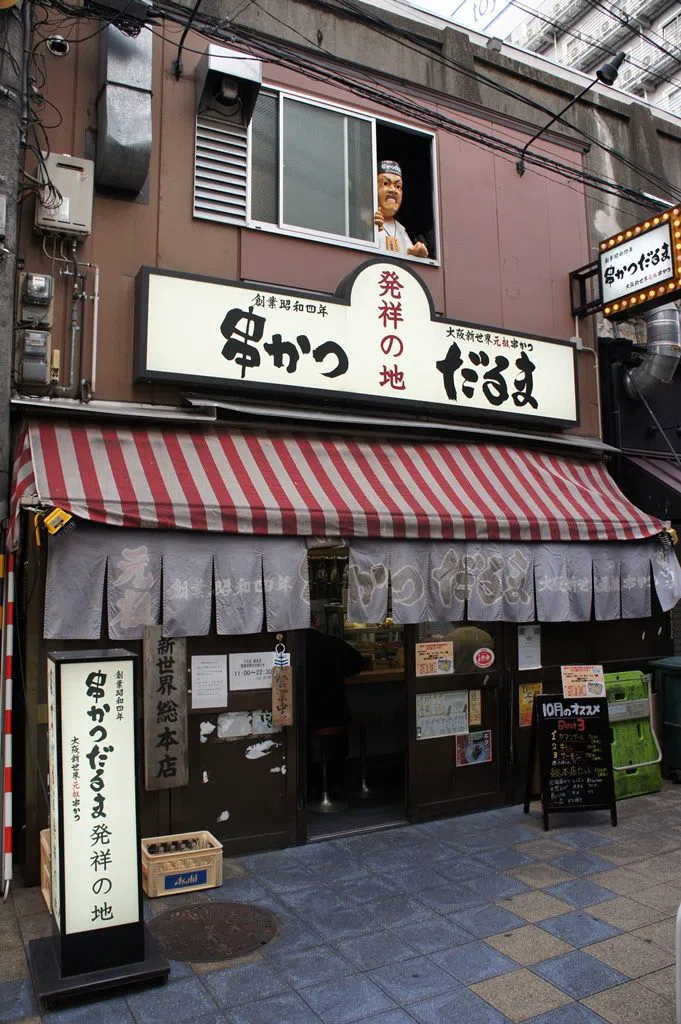
Kushikatsu Daruma (Shinsekai Honten), with its scowling chef mascot mural visible from the street, is the shop that industrialised kushikatsu into something Osaka could sell to the rest of the world. It's walk-ins only, no bookings taken, and groups queue together rather than splitting up — expect 20 to 60 minutes at peak dinner hours, less if you arrive right at opening. Budget ¥1,500–3,000 per person, with individual skewers running ¥110–300. It's the tourist-facing half of the pairing, and there's no shame in that: the food is genuinely good, the "no double-dipping the communal sauce" rule is enforced with a smile, and it's an easy first kushikatsu meal for a group that wants a table together.
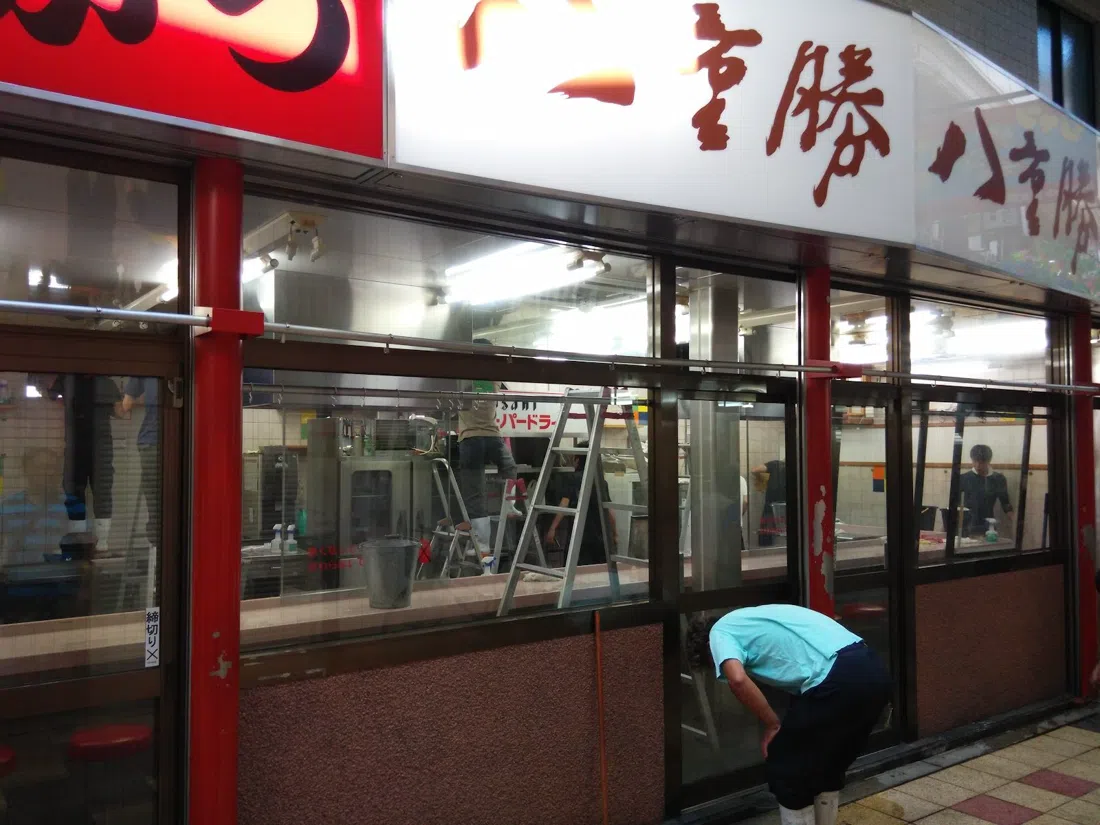
Kushikatsu Yaekatsu (Janjan Yokocho), open since 1949, is the locals' answer — the same dish served in a lower-lit, counter-only room with a queue that by local consensus is the longest in Shinsekai. There's no seating for groups beyond what the counter allows, so this suits couples or solo diners more comfortably than a party of six, and you should expect to line up single-file rather than cluster. At ¥1,000–2,500 per person it's cheaper than Daruma, and the register is different too — working-class rather than tour-bus, the shop your Osakan grandfather would have eaten at. Doing both on the same night, a few hundred metres apart, is the single best way to feel the myth-vs-reality split the whole neighbourhood runs on.
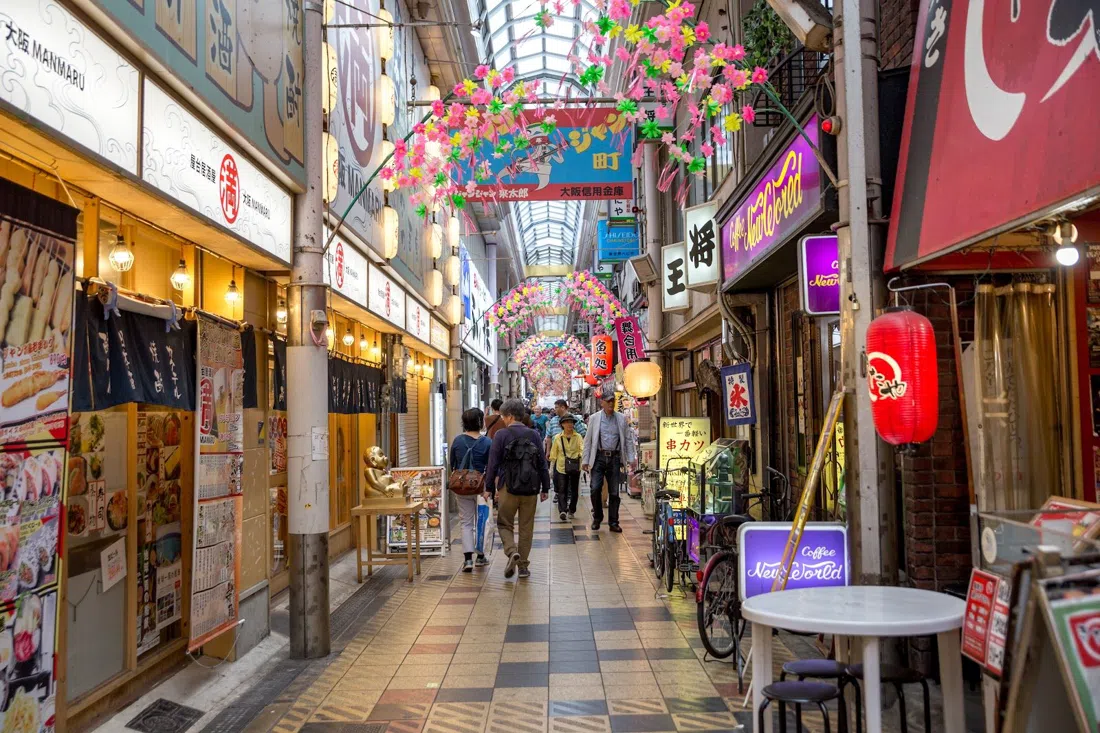
Between the two sits Janjan Yokocho (Nanyodori Shotengai), the covered arcade that is Shinsekai's shitamachi — old downtown — centrepiece. It's free to walk through at any group size, though the individual bars packed along it are tiny and genuinely elbow-to-elbow, so plan to split up once you're inside rather than move as a pack. One useful myth-vs-reality note: the shogi and go dojo that used to anchor the alley, the Sankei Club, closed in 2024 and is now a kushikatsu shop. It's not worth sending anyone hunting for the old dojo — but it's a small, honest data point about how fast even a "timeless" alley actually turns over.
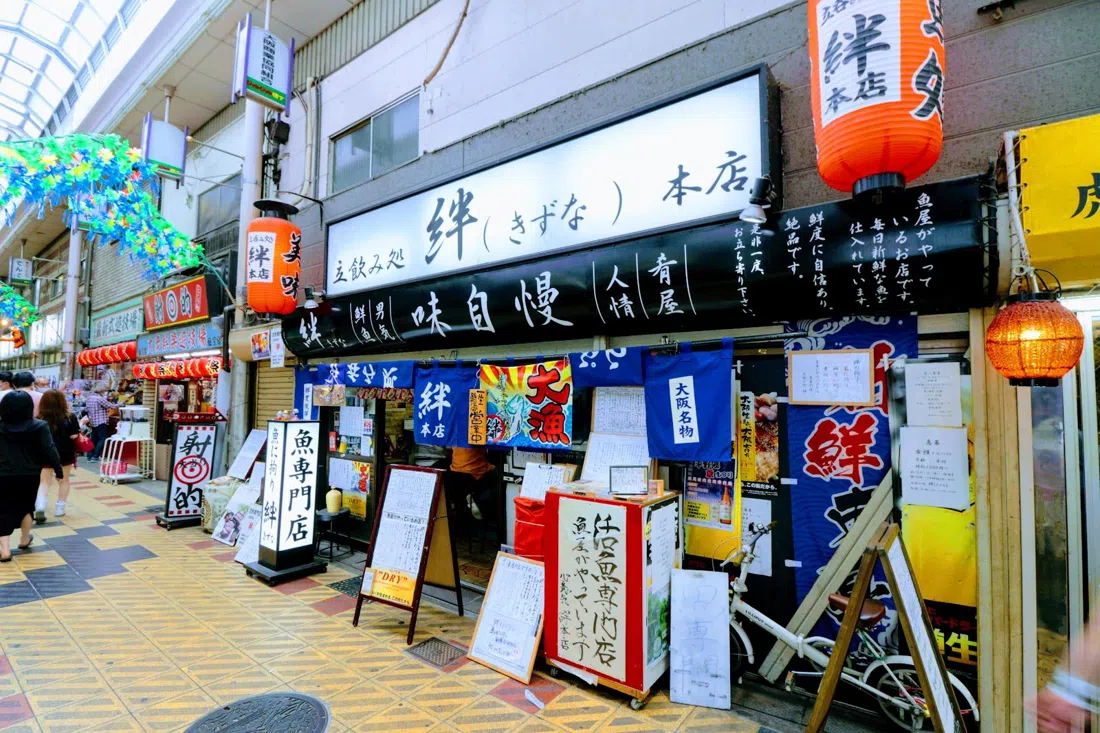
For a proper bar-hop rather than a meal, Tachinomi Dokoro Kizuna (Shinsekai Honten) is a standing bar with room for groups of two to four at the counter — closed Mondays, ¥1,000–3,000 per person with drinks at ¥300–500. It's a genuine local stop rather than a reconstruction for visitors, and it pairs naturally with a Janjan Yokocho crawl: a skewer here, a drink there, no reservations anywhere, which is exactly how the district wants to be worked.
Bathing Like a Local, and Bathing Like a Tourist
Shinsekai's other great working-class institution is the neighbourhood bathhouse, and here too there's a clean myth-vs-reality pair.
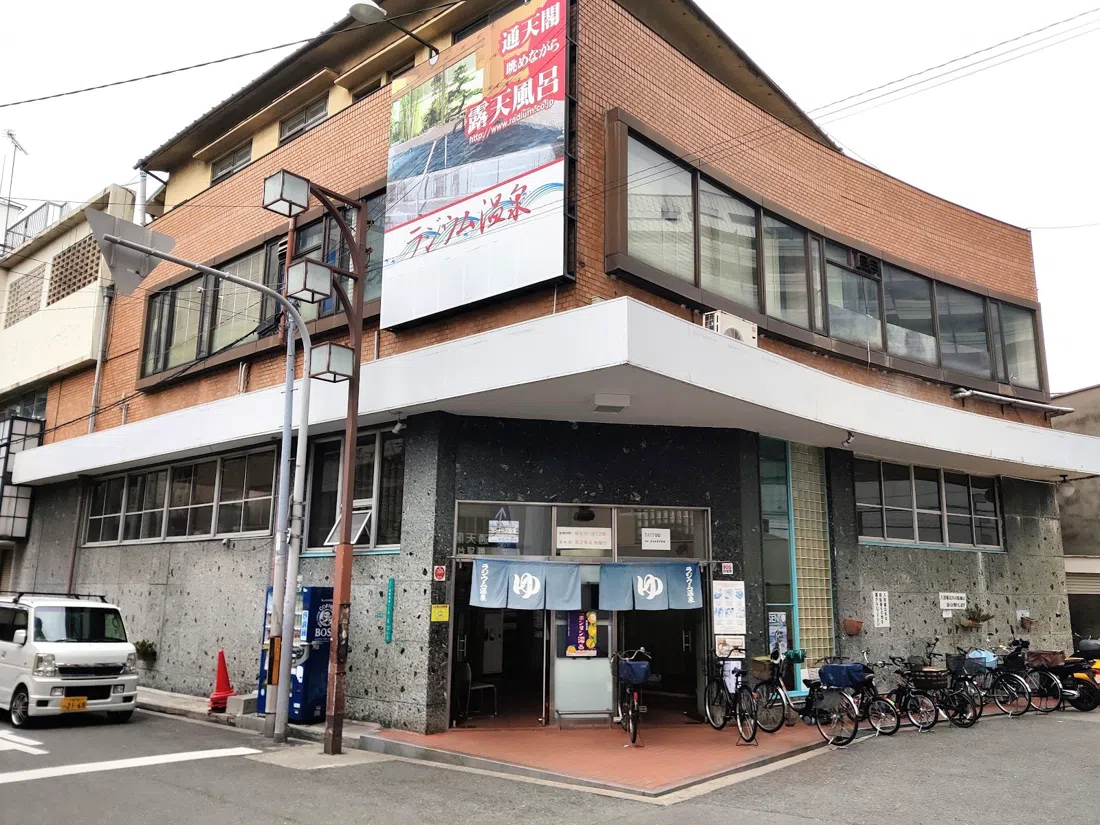
Radium Onsen (Shinsekai) has been running since 1924 and is tattoo-friendly, which matters in a country where ink still gets travellers turned away at the door elsewhere. It's communal, single-sex bathing, walk-in only, ¥700 including a towel. It suits solo travellers or pairs well; it's not really built for large mixed groups, since you'll be split by gender the moment you're through the door and the baths themselves are modest in size. This is the honest, unglamorous counterpoint to the tower's postcard image — no observation deck, no gift shop, just hot water and a district that has been quietly using it for a hundred years.
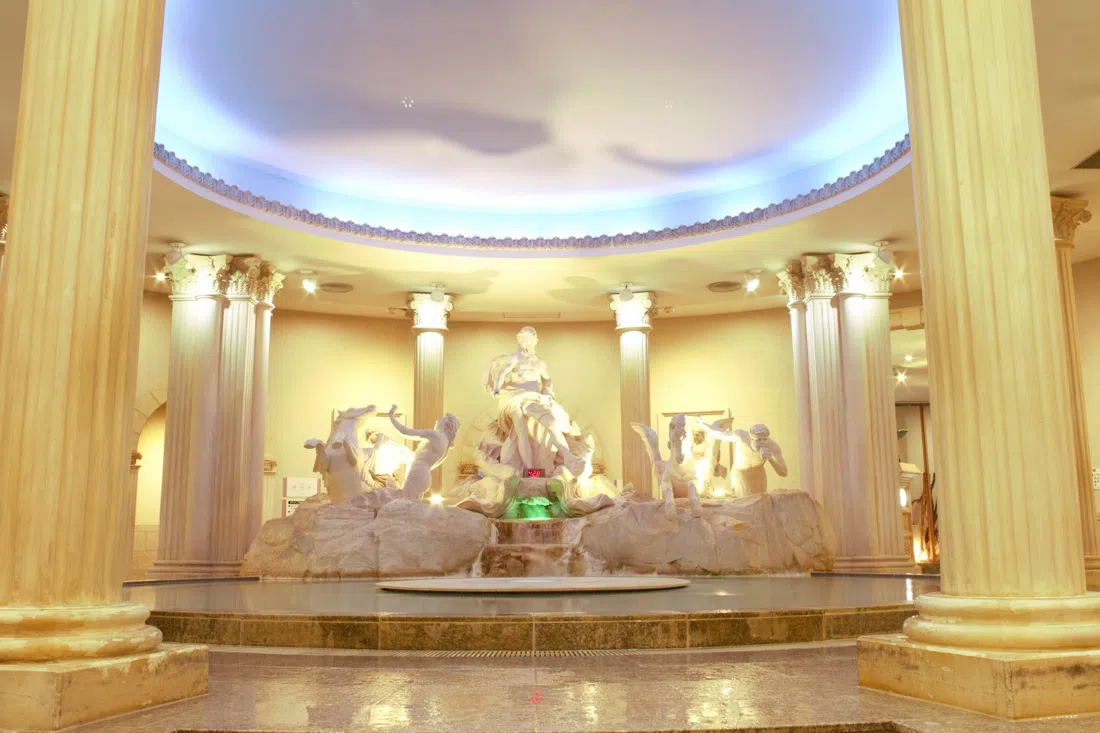
Spa World is the maximalist answer to the same need: an onsen theme park with a day-pass system, monthly gender-swap floors rotating between Asian and European-themed baths, and genuine group capacity. Admission runs roughly ¥1,500–2,500 depending on time and day of the week. It's useful as a contrast rather than a substitute — go to Spa World for a family day out or a group booking, go to Radium Onsen if you want to understand what bathing actually means to the district it sits in.
The Old City Beneath the Myth
Shinsekai's whole identity rests on being the "lower town," and a short walk in any direction proves there's a much older, deeper city underneath that framing.
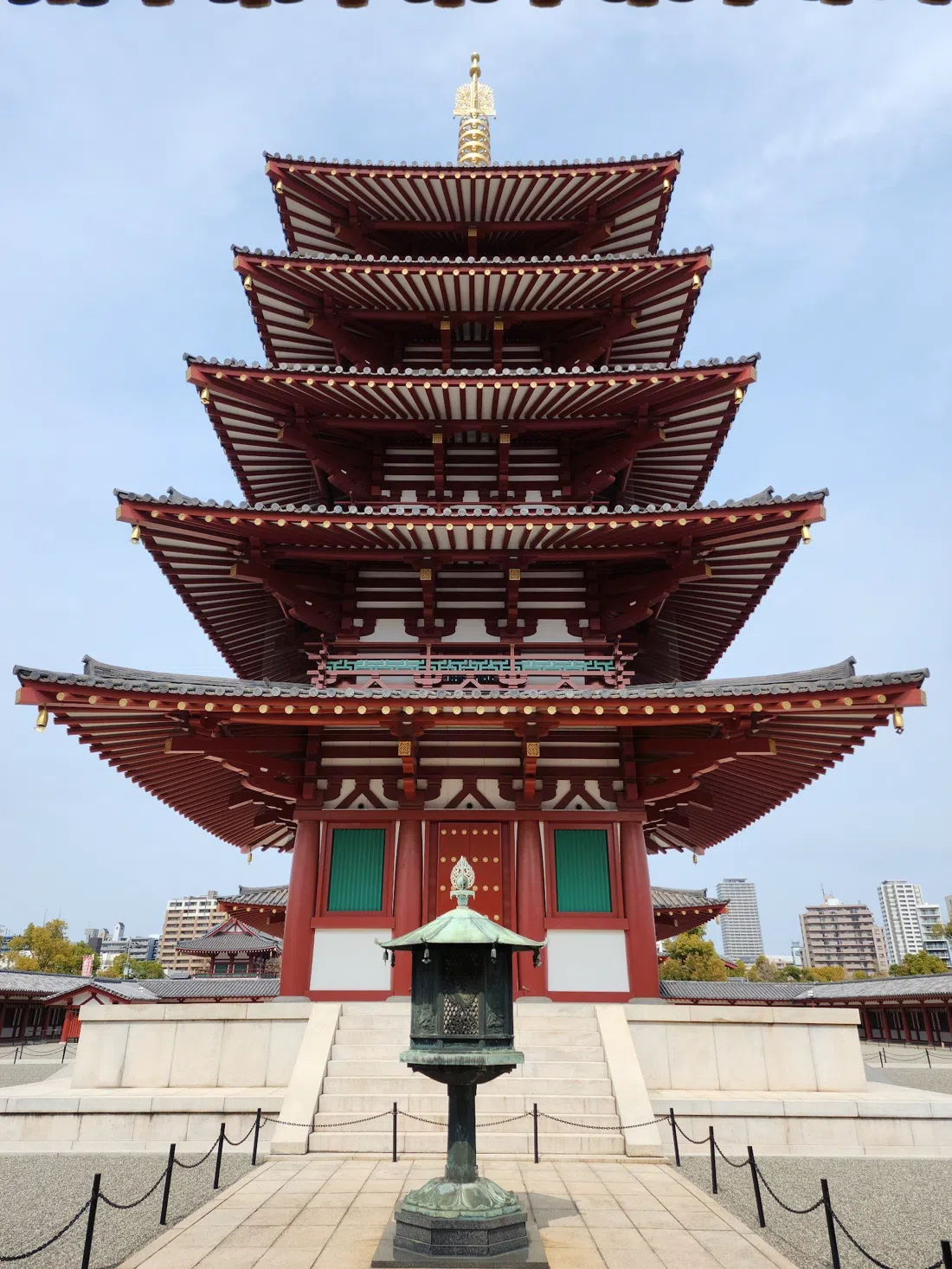
Shitennoji Temple, five minutes' walk away, is Japan's oldest officially administered temple, founded in the 6th century — a genuinely deep-history hinge that makes the tower's 1912 vintage look almost modern by comparison. The grounds are free and open to groups of any size; the inner precinct and Treasure House cost ¥300–500 if you want to go further than the courtyard. It's worth the short detour precisely because it resets the timeline — Shinsekai as a district is barely older than living memory, but the ground it stands on has been sacred for fourteen centuries.
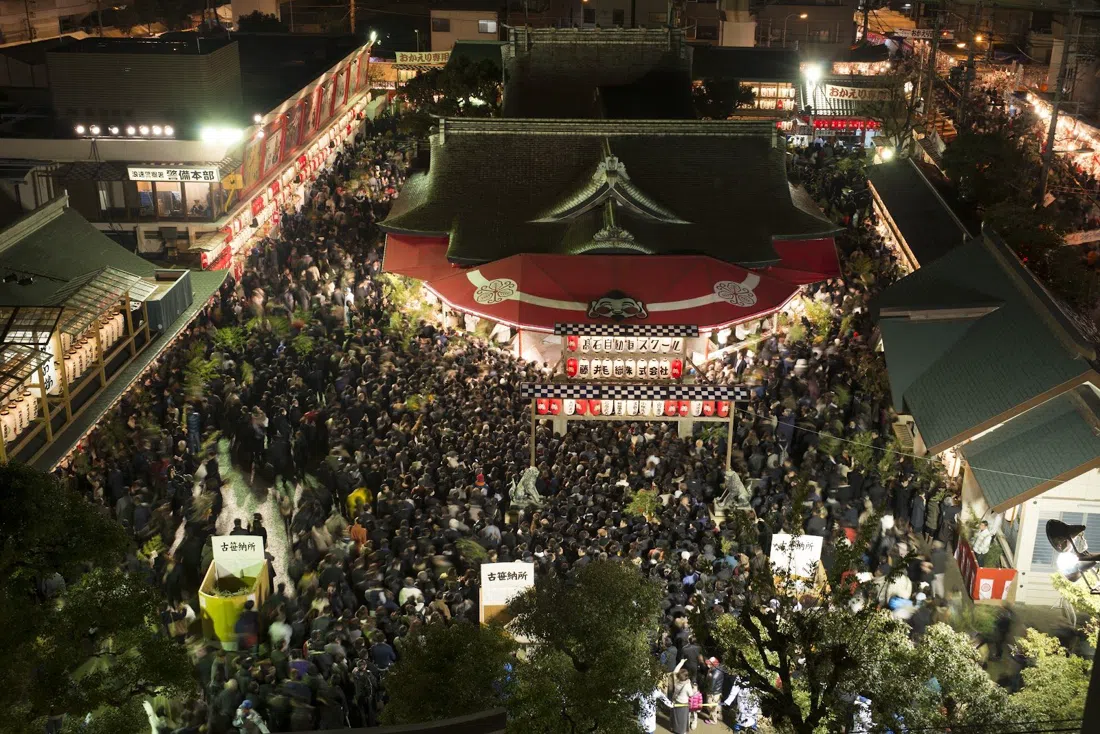
Imamiya Ebisu Shrine is Osaka's merchant-luck shrine, open grounds, free to visit, and it's arguably the purest distillation of the "working-class hope" theme in the whole neighbourhood. The Toka Ebisu festival, held every January 9th–11th, draws over a million visitors seeking fortune for the year's business — charms and bamboo branches are sold separately on festival days, priced individually. Outside festival dates it's a quiet, unhurried shrine; during Toka Ebisu it's the loudest expression of hope-as-civic-ritual you'll find in the city, tower included.
Tennoji Zoo, a short walk south, is one of Japan's oldest zoos, opened specifically to give this working district a civic amenity it wouldn't otherwise have had — the same impulse, in a different register, as rebuilding the tower in 1956. Admission is ¥500 for adults and it takes groups through standard gates without fuss. One practical note: the ongoing "Zoo 101" renovation has some enclosures closed on rotation, so it's worth checking ahead if there's a specific animal your group wants to see.
New Osaka Looks Down on Old Osaka
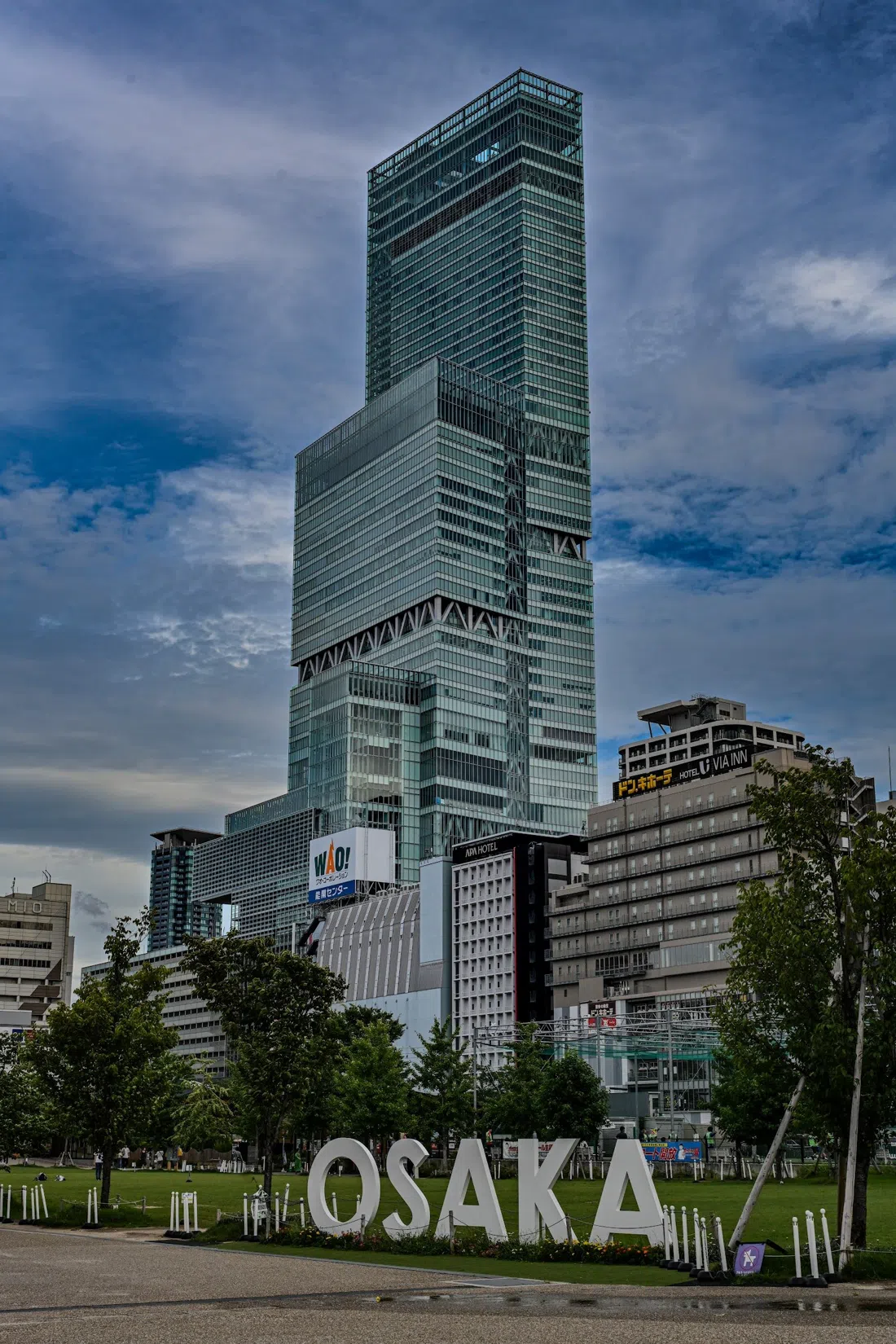
No honest piece about Tsutenkaku can avoid the tower that now looms over it. Harukas 300, the observatory atop Abeno Harukas, was until recently Japan's tallest building, and it sits close enough to Shinsekai that the view from Tsutenkaku's own deck is partly a view of being out-scaled. Adult admission is around ¥2,000, timed e-tickets are recommended especially on weekends, and it takes groups comfortably. Go up Harukas 300 and look down at Tsutenkaku, small and stubborn among the low rooftops, and the whole myth-vs-reality argument of this piece is laid out in front of you as an actual skyline: old Osaka's proudest tower, dwarfed but unmoved, still measuring its own luck on its own terms.
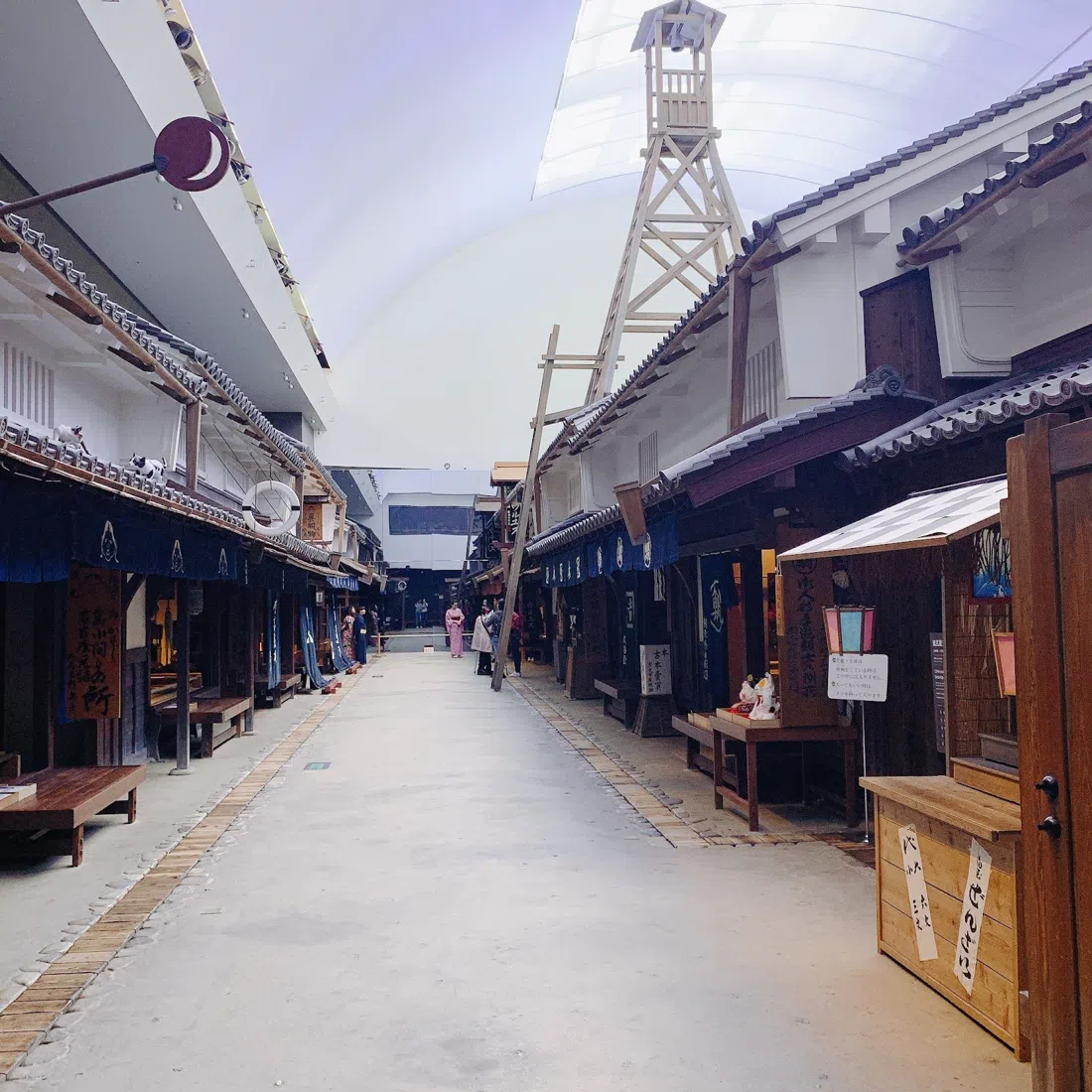
For the deepest version of that same argument, it's worth the detour north to the Osaka Museum of Housing and Living, known locally as Konjaku Kan, up in Tenjinbashi-suji rather than Shinsekai itself. It's not on the Shinsekai walking route, but it's the single best place in the city to physically stand inside the "lower town" that Tsutenkaku mythologises — a full-scale reconstructed Edo- and Meiji-era Osaka streetscape, complete with a timed light-and-sound show that cycles the room through a full day. Admission is ¥600 for adults, it's closed Tuesdays, and the streetscape floor runs a timed show so it's worth checking the schedule before you go. It takes groups, though the light-and-sound floor is more atmospheric with a small party than a large one.
Before any of this, it's worth sorting where you're sleeping — Namba and Tennoji both put Shinsekai within a 10–15 minute walk, and a well-placed Osaka hotel search will save more time than any single attraction on this list. For the rest of the city beyond this one district, the full Osaka guide covers what Shinsekai doesn't.
Getting There, Timing It, and What to Bring
Transport: Shinsekai is best reached via Dobutsuen-mae Station (Midosuji and Sakaisuji subway lines) or Shin-Imamiya Station (JR Osaka Loop Line and Nankai Main Line) — both put you within a five-minute walk of Tsutenkaku's base. If you're coming from Abeno Harukas, it's a 15–20 minute walk or a short subway hop, easily combined into one afternoon.
Cash: Bring cash. Daruma, Yaekatsu, Kizuna, and most of the stalls in Janjan Yokocho are small, family-run operations, and while card acceptance has improved since the pandemic, plenty of counters here still run cash-only, especially at the standing bars. ¥5,000–10,000 in small notes and coins covers a full day of eating and drinking without incident.
Timing: Go late afternoon into early evening — Shinsekai's neon and lantern lighting is genuinely part of the experience and daytime visits miss it, while a same-day combination with Tsutenkaku's deck at golden hour and dinner after dark is the single best sequencing. Avoid arriving right at Japanese public holidays without checking festival calendars, since Toka Ebisu in January will fill every counter in the district.
Budget: A realistic day covering the tower, two kushikatsu stops, a bar, and a bathhouse runs roughly ¥5,000–8,000 per person, excluding hotel. Add Harukas 300 or Spa World and budget another ¥1,500–2,500. None of it requires advance booking except Harukas 300's e-tickets on weekends — the entire point of Shinsekai is that you can turn up and be fed.